
The Conspiracy Kit
Create your own secret scheme theory without leaving your home

I had just compared the Bluestone Town Center decision to the golf course decision two dozen years ago. The long-time critic of my vote to continue construction of the amenity said, “I wasn’t going to bring it up.”
I pointed out to him that at least I’d warned people two weeks before the election that I might have to vote for the thing. Knowing I don’t generally lie about history or politics, the other guy looked across the table and said, “I didn’t know that.” I explained that most people didn’t because the local newspaper didn’t necessarily want them to.
The friend I was talking to is a conspiracy theorist, of sorts. A lot of people tend that way because their imaginations are not big enough to understand the level of happenstance, coincidence, incompetence, and misinterpretation that goes into the decisions of those running the government and the world. Faced with that strong majority of public decisions that make no sense or fly in the face of known facts, the theorist takes a known fact and builds from it, eventually formulating a sequence of events that makes sense but is far removed from reality.
That was one way to explain that long-ago vote. I would explain that stopping the project would have hurt the city’s credibility and bond rating and cost us a $100,000 penalty, but they knew it wasn’t that simple. There had to be something else, even if they didn’t know what. I quipped to a long-time political operative that I felt like I’d given away a $20,000 vote. “Yeah, we’d meant to talk to you about that,” he said. I think he was kidding
.
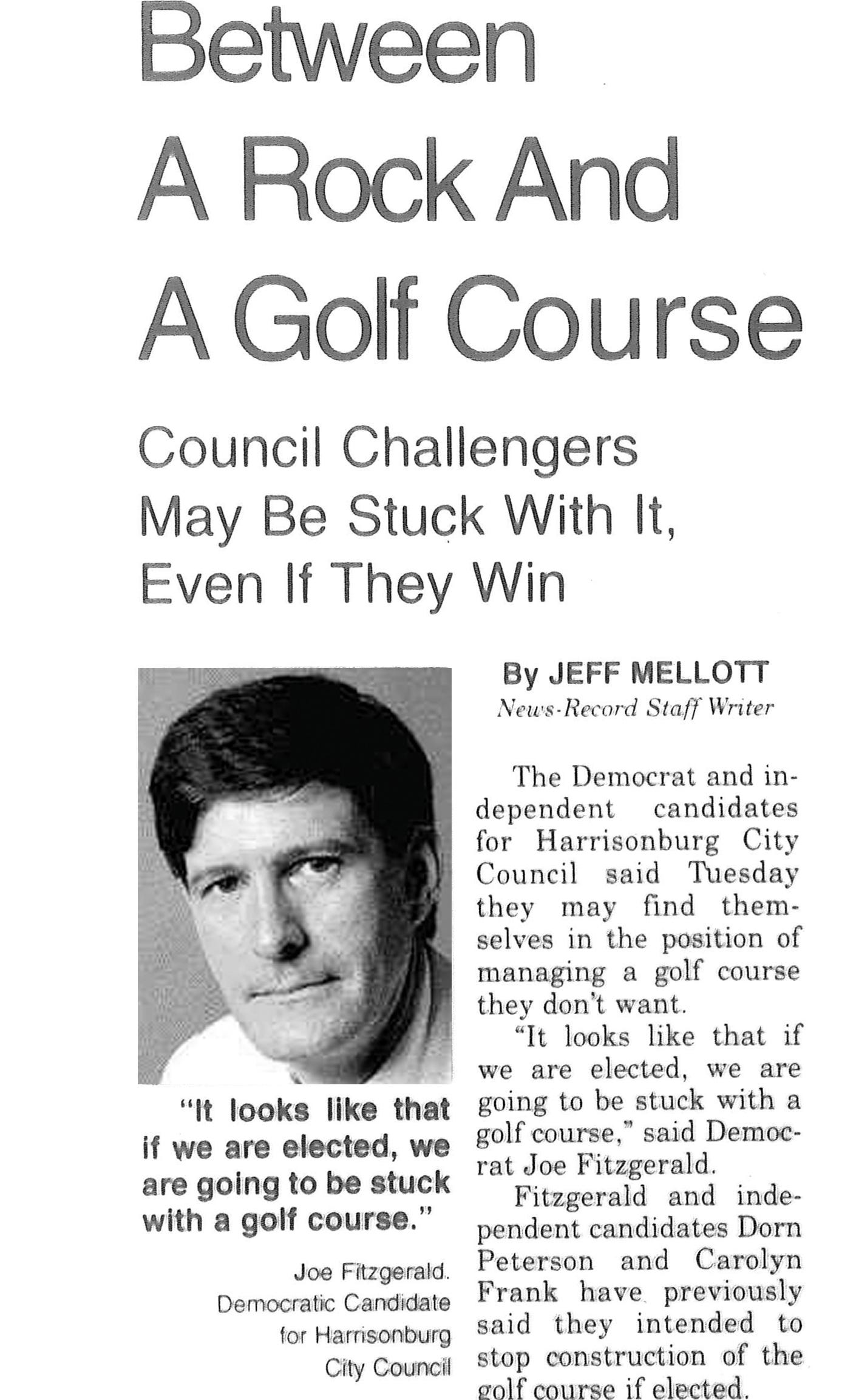
Anyway, I explained to the golf course critic that a lot of people didn’t know that I’d said before the election that we’d be stuck with it. The problem, I explained, was that it was never really in a headline. I explained about the main lead news story, the one bannered across the top of the page. The story wasn’t there. There was a news feature story. And I explained that when you put a feature there, the lead is an off-lead, down and to the right. Because the general theory was that people read newspaper pages clockwise. Individual stories, up and down, left to right. But the page as a whole, clockwise.
For reference, keep in mind that theory at the time also said newspapers would last forever. So there may be some play in the speculation.
The story about me more or less admitting we couldn’t stop the golf course wasn’t the lead or the off-lead. It could have been. Who would win the election and what that would mean for the golf course were the two big questions that month. April 2000 had begun with a poll showing a majority of voters opposed the project. That same week, the city signed a contract and began cutting trees to build the course.
With the golf course under way, and one of the three people needed to stop it admitting they couldn’t, there wasn’t a whole lot of reason to vote for us. I’ve previously conceded that there wasn’t anyway, but elections don’t have to make sense. But suppose people didn’t really know I’d said we’d be stuck with it. Suppose further that the main news editor at the Daily News-Record was opposed to the golf course and wanted us, the opponents of the course, to win the election. Do keep in mind that suppose plus suppose is kind of like multiplying fractions. Chances shrink instead of growing, counter-intuitive though it may be. So speculation added to speculation means there’s progressively less chance of being right the more you speculate.
But let’s continue anyway. That’s how these things work.
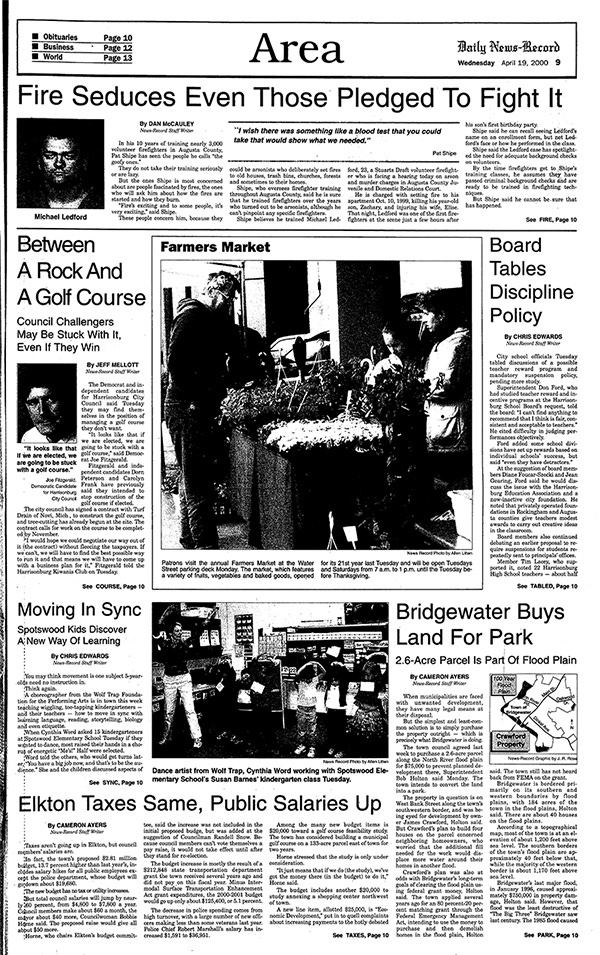
Suppose you’re a newspaper editor, and want an election to go a certain way, but something happens that’s going to produce a game-changing headline. “Golf Course To Proceed, Opponent Admits.” One option is not to put it across the top of the page. Another is to give it a feature headline. “Between A Rock And A Golf Course.” What does that even mean? And for the sub-head, the deck in newsroom parlance, make it a maybe and don’t attribute it to the candidate. Use a pull-quote, sure, but put it underneath a photo of a political candidate so staggeringly good-looking nobody’s going to read the quote. Women sigh and boys weep, but what did he say?
Is or was the newspaper too ethical to slant its coverage for political reasons? Puh-leeze. The first paragraph identifies a “Democrat” candidate, a phrase used only by the Republican right, instead of the more common “Democratic.” Granted, the rightist editor still wanted me to win because I was against a project he didn’t like. I’m sure he was as conflicted as a hard-core Mennonite looking at a sign that says “Free Beer.”
I explained all this to the golf course critic, and pointed out that for somebody reading the page clockwise, the story about my admission was the last thing on the page.
I kind of wondered if he knew I was kidding. I kind of wondered if I was.